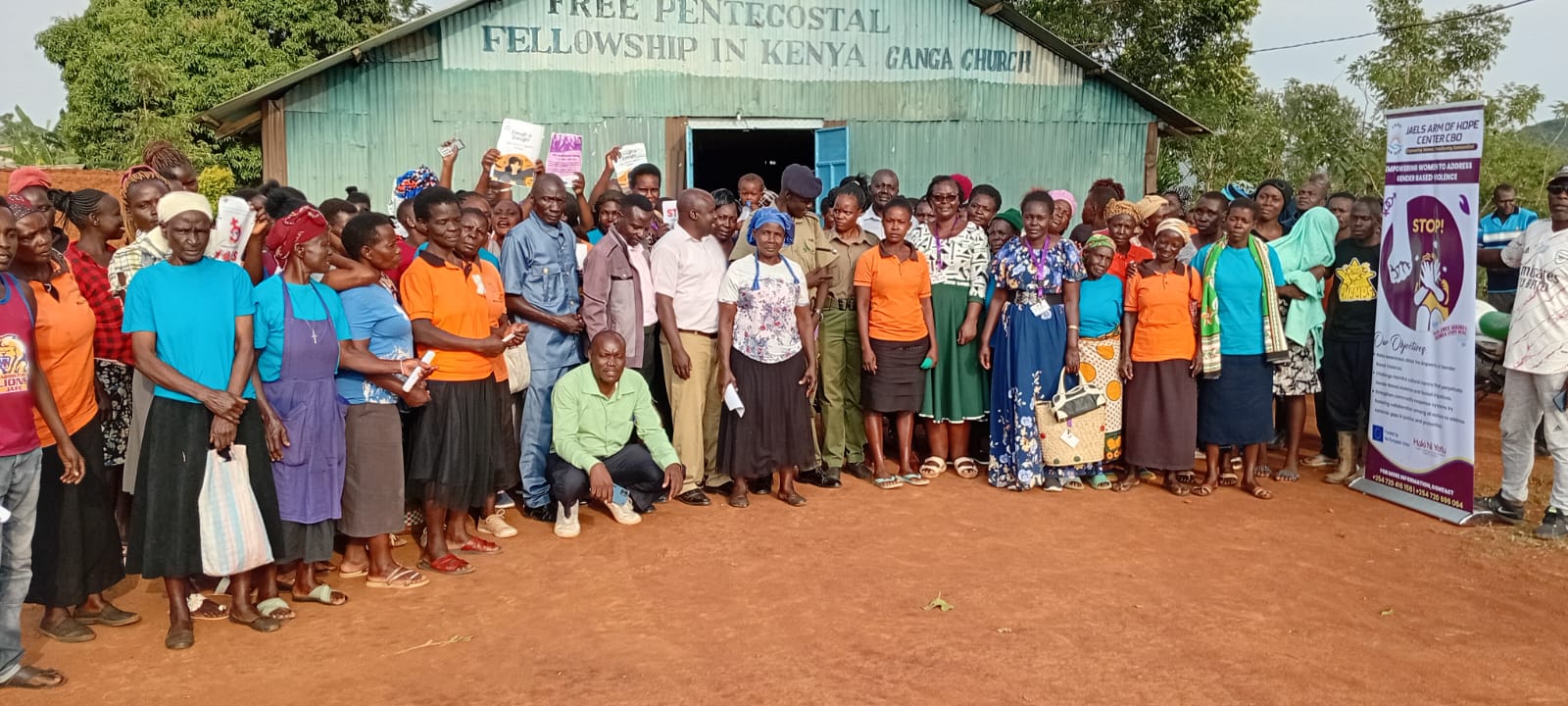

When we launched our project, Empowering Women to Address Gender-Based Violence in Bwiri, under the Haki Ni Yetu Project, supported by the European Union in Kenya through the Civic Action and Community Empowerment Grants (CACEG) sometime in October 2025, we knew that although we had already been working in this space without funding, having resources meant we were entering a phase that required even more patience, trust, and honest conversation. Gender-Based Violence (GBV) in Bwiri Ward is not only a legal issue but also a serious social challenge, often hidden behind fear, stigma, and the belief that it is a “family matter.”
From the start, our focus has been to take the conversation directly to the people. We organized our first sensitization workshop in Hakati, followed by Busembe, Namuduru, and later Busijo during the second phase this year, all using churches, community forums, and group meetings as safe spaces for dialogue. We worked closely with religious leaders, recognizing that many women experiencing GBV often confide in them and share their struggles. These discussions have helped community members understand what GBV is, how it affects families and children, and why silence only allows violence to continue. Women shared sad and sometimes horrific experiences they had never spoken about publicly, while men asked important questions about culture, inheritance, and their role in preventing violence.
Alongside awareness sessions, we also held legal aid and counselling activities. In one session, a survivor who had lived in fear for a long time was supported by a medical practitioner, a mental health advocate, and our Executive Officer, Madam Pauline Nagila, who is a trained paralegal. She was encouraged to report her case and reminded that she was not alone. Moments like this showed me that although awareness precedes change, it must go hand in hand with support, and that we must always go beyond talking to taking action against this pervasive problem.
These four sub-location engagements later culminated in a Ward-level stakeholders’ forum that we recently held in Ganga Town at the Free Pentecostal Church, bringing together duty bearers, religious leaders, community volunteers, and local administrators, amongst them, the Deputy OCS and Gender Desk officer drawn from Ganga Police Station. The forum created a united platform to reflect on lessons from the grassroots and to strengthen community response systems. Leaders present emphasized the need to break the culture of silence and committed themselves to fair and supportive handling of GBV cases.
Beyond community activities, our project through the Haki ni Yetu has also strengthened our organizational capacity. Through coaching and mentorship on monitoring and evaluation, financial management, and visibility, we have improved how we document our work and tell our story. We are now better equipped to track change, report responsibly, and share lessons from the ground.
So far, the most important shift we have seen is in attitudes, and that is what makes us proud, even though we know we are not there yet. People are speaking more openly about GBV, survivors are seeking help, and duty bearers are engaging more closely with the community. While challenges remain, such as the lack of a safe space for survivors in Bwiri, this growing openness shows that change is possible when conversations are held in familiar, local, and trusted spaces.
As we continue with implementation, our message remains clear: GBV should not be hidden, normalized, or excused. It must be addressed together as a community.
The Writer, Oscar Ryan Ouma is the Programs Officer, Jael's Arm of Hope Center